Kids, mommy and daddy have something to tell you...
No, just kidding! This is about team racing, and to encourage you to start thinking about the separation you either want to gain from a competitor's boat, or that you want to eliminate between yourself and a competitor.
When you are trying to restrict a competitor from maneuvering, you want to minimize separation. If you are 2' away from a boat, they can't gybe without fouling you. If you are 2' away from a boat to leeward and want to gybe, you are going to need to increase the separation. If you want to prevent that boat from gybing, you don't want to let them increase separation.
Sometimes not enough separation from a boat you are trying to control is dangerous. This week already, I have seen a lot (and fallen victim myself) of fouls where a give way boat gets so close to a right of way boat that it can't keep clear (and that's a definition in the rules so it's italicized). When you're beating, and you're the boat to windward trying to slow down boat you have pinned to leeward (as when doing a pass back), you want to make sure you've got enough separation to not drift into that boat. How much is enough? Depends upon the situation.
When you are in a tacking duel, the boat behind wants to create separation enough to keep tacking to accomplish the purpose of the duel. The behind boat's purpose is often to get to the right of the boat ahead with enough separation to come back at the boat ahead on starboard, and gain starboard tack advantage. Oftentimes the boat behind is motivated to just keep tacking to slow the boat ahead, so that a team mate can sail through. You've lost a tacking duel if the boat ahead is able to close down your separation so that you can no longer tack and are pinned.
A boat behind on a run is trying not to get hooked by a boat ahead. The boat behind wants to maintain enough separation to the boat ahead to be able to engage boats behind without being engaged by the boat ahead.
If you get to a stable combination, you are trying to decrease separation to the finish line! The best route to that is generally not letting any of your pairs get too much separation away from your team.
There are a million examples of this in a team race, and they are all pretty straightforward. You might be trying to increase it, you might be trying to decrease it, or you might be trying to maintain it, but in team racing you want to think a whole whole lot about separation.
Wednesday, October 31, 2018

Monday, October 1, 2018
Trust the process, be patient
This post has been severely edited to make it shorter and better.
When they're learning to walk, babies get frustrated and they cry, but they don't give up. Somewhere deep in their little baby brains, they trust the process. When they fall down, they don't say "screw it, crawling works so well for my needs, I'll just get better at that!"
The sailors among you who are most committed to the process and trust it the most are the ones who will improve the most and get there the fastest.
It's easy to think "ahh, screw it, crawling works out great, I get wherever I need to go, I never fall down, why do I need to learn to walk and go through all that trouble?" From what I see, none of you took that approach as babies. Don't take it now.
Trust the process, falls and frustration and all.
When they're learning to walk, babies get frustrated and they cry, but they don't give up. Somewhere deep in their little baby brains, they trust the process. When they fall down, they don't say "screw it, crawling works so well for my needs, I'll just get better at that!"
The sailors among you who are most committed to the process and trust it the most are the ones who will improve the most and get there the fastest.
It's easy to think "ahh, screw it, crawling works out great, I get wherever I need to go, I never fall down, why do I need to learn to walk and go through all that trouble?" From what I see, none of you took that approach as babies. Don't take it now.
Trust the process, falls and frustration and all.
Monday, September 17, 2018
Who Gains?
It's easy to lead with the results from the weekend, but instead I'd like to lead with the work during the week that went into enabling those results. We had a great week of practice. Early in the week with mostly upper class boats we got a ton of work done on starting (Kate was in the coach boat with me that day), and we kept the heat on starting all week. Tons of tacking and gybing practice, as well as mark roundings, and a bunch of sail trim stuff.


This all resulted in a situation on the river where, for example, even though I was standing on Harvard's dock, I could easily make out a top mark rounding that Caitlin and Luke did just by their technique. It was way better than the boats around and they gained on the boats ahead and stretched on the boats behind. The women's tacks and gybes, relative to the fleets they sailed in, were at a consistently high level, by which I mean some boats sometimes tacked and gybed as well as us at times, but we hit that level more consistently than other teams.
Good work pays off. There is a great saying "an amateur practices until s/he can do it right, but a pro practices until s/he can't do it wrong." I'd like for us to get to the point where we outgrow the ability to do it wrong. Lots more work, but we should all be excited to see the sign posts of progress.
Today's post focuses on relative gains in headers and lifts. If two boats are sailing along, one of them gains in some situations and the other gains in other situations. The most common ones follow as diagrams.
In situation 1, we have Boat L (leeward boat) and Boat W (windward boat). They are even with each other, L being an equal amount forward on W as W is above L.


If we get a header in this situation, the boats will rotate clockwise (since they are sailing on starboard), and as you can easily see, Boat L makes a gain in this situation.

Conversely, if they get lifted, Boat W makes a gain.

Simple enough, right?
Then we go to a situation in which one boat is directly behind the other, as shown by Boats A (Ahead) and Boat B (Behind). This is a situation you would often see exiting a leeward mark or potentially at other points during the race.

So let's give these boats a header and see what happens:

Boat A clearly gains in the header, right? Now lets go back and give them a lift instead.

What I'd like you to do for now is to internalize these scenarios and how they play out, so that you instinctively know how a wind shift is going to affect you relative to the boats around you. Good, effective, fast decision making depends on pattern recognition. These are simple patterns, and they need to become hardwired into your brain. Think about them, flip them over in your mind, ask the coaches about how these work, but eventually they need to become part of your hard drive.
Sunday, September 9, 2018
PBO Week
Today's title will mean nothing to most of you since you weren't there, but it will be how I remember this week most easily so that's what this post is called. This is more of a notes post for myself. Things will get more fleshed out in later posts but these notes will help me remember the week and keep thoughts alive.

We've made a lot of mechanics progress this last week and I feel like some strategic/tactics progress too.
Having seen us in a regatta, starts are a limiter (read about limiters here and in the post before it). Line sighting, downspeed boat handling, boat control, these are all issues.

I wonder about the psychology of the team in practice vs at regattas. From the results I've seen (and results aren't the whole story), the team's results this weekend weren't what I'd have expected. Quite simply, though I don't place judgmental expectations on the team, if I'd been asked to guess what our results would havei been this weekend I'd say most of our events would have wound up around 5th or maybe a bit better or worse. We did that well in only one event. That was surprising. Either my impressions of how well the team is sailing in practice is skewed in some way, or the level of competition is quite a bit higher than expectations, or our team underperformed relative to our sailing level in practices. I'd guess a lot of it is the latter but I don't know. Some of it will just take time to learn. We'll look into that.

Aidan and Lauren did a luff duck in one race today and it made my week. They passed at least 2 boats because of it, I was ecstatic to see them whip the move out, in an appropriate situation, and then execute it well, and then have it pay off big. That was really really cool.
I think we might need to introduce a bit more competition into practices. I think our practices are productive and instructive and well run and they have a ton to recommend them, but I wonder whether we're missing out on competitive situations. Tough saying.

PBO was a really pretty event.

We've made a lot of mechanics progress this last week and I feel like some strategic/tactics progress too.
Having seen us in a regatta, starts are a limiter (read about limiters here and in the post before it). Line sighting, downspeed boat handling, boat control, these are all issues.

I wonder about the psychology of the team in practice vs at regattas. From the results I've seen (and results aren't the whole story), the team's results this weekend weren't what I'd have expected. Quite simply, though I don't place judgmental expectations on the team, if I'd been asked to guess what our results would havei been this weekend I'd say most of our events would have wound up around 5th or maybe a bit better or worse. We did that well in only one event. That was surprising. Either my impressions of how well the team is sailing in practice is skewed in some way, or the level of competition is quite a bit higher than expectations, or our team underperformed relative to our sailing level in practices. I'd guess a lot of it is the latter but I don't know. Some of it will just take time to learn. We'll look into that.

Aidan and Lauren did a luff duck in one race today and it made my week. They passed at least 2 boats because of it, I was ecstatic to see them whip the move out, in an appropriate situation, and then execute it well, and then have it pay off big. That was really really cool.
I think we might need to introduce a bit more competition into practices. I think our practices are productive and instructive and well run and they have a ton to recommend them, but I wonder whether we're missing out on competitive situations. Tough saying.

PBO was a really pretty event.
Thursday, September 6, 2018
FJ tacks and gybes
9/5 practice notes:
Yesterday was a productive day. Being productive is fairly easy in perfect conditions, and we managed to nail that. Hooray us.
Most skippers way oversteer into the FJ tacks in flat water. The boat loses almost no momentum as you turn into the tack in flat water so you don't have to steer fast. Steering into the tack more gently gains windward distance relative to a quicker tack, and allows a good roll and fast exit from the tack.
There is NO preroll in an FJ tack, except in very light air if you are trying to cheat. So there is no preroll in an FJ tack. The skipper's body movement is to slide your butt aft enough to point both knees forward as you turn the boat into the wind, and then give a good solid upper body roll as the jib backs (most were doing this roll way too early yesterday - the best FJ crews will nearly universally say that in light and medium air the roll happens as the jib backs enough to hit the mast, which is way later than most of you are used to rolling), and then cross and flatten.
Crews need to work on footwork in the tacks, as a lot of people got hung up in the straps. It is no crime to look at your feet during every tack for a day to learn what they are doing and how they are interacting with the boat. Your tacks won't be the best during this process but we are investing in learning here. You will be better after this process.
In a proper light/medium wind to wing FJ gybe, the hardest part is not spinning out to windward on the new gybe. If everything is done right in the first steps, it's going to be easy to spin out. But if you manage to avoid spinning out, your gybes will be awesome.
Step 1 is "we're gybing." The crew takes the jib sheet from the skipper and KEEPS THE JIB FLYING. #1 mistake yesterday was everyone just dropped the jib in the beginning of the gybe. That's slow. Board goes some of the way down. Less in an FJ than in a 420, more on this in a later post.
Step 2 is a very very (very) small steer into the gybe, while the crew shifts weight to windward and the full jib helps steer the boat down. Windward heel and a full jib make steering almost unnecessary. The boom is flipped over and the skipper crosses and immediately goes to a pretty aggressive "weight out" position as you turn the boat fairly hard downwind. THIS IS THE MOST RUDDER MOVEMENT OF THE GYBE but it's still not huge. The crew also helps to get the boat heeling to windward as soon as the boom switches sides. You have to get used to the feeling that you are going to spin down into a death roll - that is the correct feeling, you just don't actually do the death roll part.
As the boat is turning down, the crew is already gybing the jib with a very hard pull of the sheet through the block, after which the skipper takes the sheet to wing the jib, board goes back up, and you are off and running.
Other notes:
Most people have too much vang most of the time. Your vang should be slack in pre-start, unless you have an excellent reason otherwise. If you head down with the vang on, you accelerate. Most of the time you are heading down in pre-start, you are trying to pivot to protect your hole. Accelerating screws that up completely.
There is a reason that I will encourage you to sail backward every day. It is not just for show. Boat control on the starting line is VERY IMPORTANT, being able to back the boat is a big part of that but also one of the most effective start line boat position moves is being able to head the boat down from nearly head to wind to close hauled by simply pushing your boom out hard once, quickly. It's a tough move to master, almost no people truly get it (I had it nailed for about 3 years and now don't practice anywhere close to enough so I stink at it), and sailing backward is THE key step in learning it.
Yesterday was a productive day. Being productive is fairly easy in perfect conditions, and we managed to nail that. Hooray us.
Most skippers way oversteer into the FJ tacks in flat water. The boat loses almost no momentum as you turn into the tack in flat water so you don't have to steer fast. Steering into the tack more gently gains windward distance relative to a quicker tack, and allows a good roll and fast exit from the tack.
There is NO preroll in an FJ tack, except in very light air if you are trying to cheat. So there is no preroll in an FJ tack. The skipper's body movement is to slide your butt aft enough to point both knees forward as you turn the boat into the wind, and then give a good solid upper body roll as the jib backs (most were doing this roll way too early yesterday - the best FJ crews will nearly universally say that in light and medium air the roll happens as the jib backs enough to hit the mast, which is way later than most of you are used to rolling), and then cross and flatten.
Crews need to work on footwork in the tacks, as a lot of people got hung up in the straps. It is no crime to look at your feet during every tack for a day to learn what they are doing and how they are interacting with the boat. Your tacks won't be the best during this process but we are investing in learning here. You will be better after this process.
In a proper light/medium wind to wing FJ gybe, the hardest part is not spinning out to windward on the new gybe. If everything is done right in the first steps, it's going to be easy to spin out. But if you manage to avoid spinning out, your gybes will be awesome.
Step 1 is "we're gybing." The crew takes the jib sheet from the skipper and KEEPS THE JIB FLYING. #1 mistake yesterday was everyone just dropped the jib in the beginning of the gybe. That's slow. Board goes some of the way down. Less in an FJ than in a 420, more on this in a later post.
Step 2 is a very very (very) small steer into the gybe, while the crew shifts weight to windward and the full jib helps steer the boat down. Windward heel and a full jib make steering almost unnecessary. The boom is flipped over and the skipper crosses and immediately goes to a pretty aggressive "weight out" position as you turn the boat fairly hard downwind. THIS IS THE MOST RUDDER MOVEMENT OF THE GYBE but it's still not huge. The crew also helps to get the boat heeling to windward as soon as the boom switches sides. You have to get used to the feeling that you are going to spin down into a death roll - that is the correct feeling, you just don't actually do the death roll part.
As the boat is turning down, the crew is already gybing the jib with a very hard pull of the sheet through the block, after which the skipper takes the sheet to wing the jib, board goes back up, and you are off and running.
Other notes:
Most people have too much vang most of the time. Your vang should be slack in pre-start, unless you have an excellent reason otherwise. If you head down with the vang on, you accelerate. Most of the time you are heading down in pre-start, you are trying to pivot to protect your hole. Accelerating screws that up completely.
There is a reason that I will encourage you to sail backward every day. It is not just for show. Boat control on the starting line is VERY IMPORTANT, being able to back the boat is a big part of that but also one of the most effective start line boat position moves is being able to head the boat down from nearly head to wind to close hauled by simply pushing your boom out hard once, quickly. It's a tough move to master, almost no people truly get it (I had it nailed for about 3 years and now don't practice anywhere close to enough so I stink at it), and sailing backward is THE key step in learning it.
Monday, October 2, 2017
J24 sailing late summer/early fall
If any SG kids are still subscribed to this thing, I'm going to use it as my sailing notebook since I've been doing a bunch more sailing of my own lately. You're more than welcome to read it, it may be super helpful, but I'm writing it for myself and I have a tendency to use naughty words when I do that so fair warning. You'll also see crew names but I'm only using last initials at most. This is one of those times where you get to choose to be cool or a jerk in life. If you figure out who someone is and I have a critique of him or her, please keep it to yourself. It's the height of uncool to do otherwise.
J24 Thursday night 8/10
Conditions: Light southerly, slight ebb.
Boat: Buckshot
Crew: Steven drive, Larry trim, Jane mast, Tom K bow, DK tactics
Result: 8, 1 (no clue overall)
Race 1: We had an okay start and good speed and all the right answers on where to go, there was just so much fucking chatter on board that I got drowned out and we fucked up the beat and had to pull an OK top mark rounding out of my socks, then same thing happened on the run and we got neck punched. I almost jumped off the boat, swam in, and re-quit sailing.
Race 2: I asked for a lot less chatter and people were cool about it, we rounded top mark close 3rd, made a fairly ballsy split at a cruise ship, corralled people into one another effectively, launched to a big lead and won easily.
Summary - it seemed easy to win on a quiet boat with good wheels and impossible to win on a chatterbox
J24 40th Anniversary Race 8/11
Conditions: Mealy southerly, very strong ebb
Boat: Buckshot
Crew: Steven drive, Larry trim, Jane mast, Bianca bow, DK tactics.
Race 1 (of 1): Weird port at pin start that was effective, early decision to go left for Ft Adams wall lefty plus get into more current quicker. Maybe more aggressive than would have approached a race in a series but in this race you either won or who cares what you got, so be aggressive. We rounded mark 1 with a nice lead. Ducked the current well out of mark 1 even though it wasn't sailing most toward the mark. Nice gain against boats that gybed early and extended toward the Rose Island current relief.
Larry and I (really Larry) made the call to go west of Gould and that worked. Despite the leeward mark (the green north of 1/2 way rock) being invisible, I had the chart marked so we were able to find it without much drama. The rest of the race was kind of easy and boring. There were no passing lanes and we had good speed. 4 past class world champions (at least) had a shiny spot on their mantle all cleared off for that trophy, but now they get to come look at it anytime they want to.
J24 J/Fest 8/12 and 13
Conditions: No racing Saturday; fog and medium southerly with moderate ebb Sunday
Boat: Buckshot
Crew: Steven drive, Larry trim, John mast, Bianca bow, DK tactics
Race 1 we knew where the mark was because I'd marked the chart and seemingly no other boats had. We had a crap start with okay to good wheels but rounded top mark second because we knew where we were going. Passed the slower lead boat on the run and won.
Race 2 not great start, got pinballed around because who doesn't like to tack on the boat that won the last three races you've sailed, got nearly taken out by A-Salt on the run, grovelled back for 6th.
Race 3 terrible start, got flushed out right, got good pressure immediately and stuck with it, then got the header to make it a superfecta and that game was over. Win.
Race 4 okay to meh start, good speed, terrific play to put the boats we'd passed by gybing away into each other, extended up the last beat into a SUPER dying breeze and game, set, match.
J70 tuning 8/15
Don't pull the main in as hard on a J70 as you would a J24. It's an Etchells with an asym. Change your battens to meet conditions. That's about it.
J24 coaching 9/7&8
See North Facebook videos. Power pointing versus shape pointing. Mast butt forward against lowers to corral headstay and prevent over bend. Traveler up HIGH in J24 when vang sheeting so sheet is on a pure in and out plane. Sail upwind in a full luff when it's super nuking.
J24 Changing of the Colors 9/29 - 10/1
Boat: Bogus
Crew: Mike drive, Will trim, Rachel mast, Dave M bow, DK tactics
Day 1: Light. You can be aggressive when it's light and crazy, but you don't want to invite disaster to your door. Despite carding a 1, 1 I would actually say we were the most conservative of the relevant boats. Yes we won both races but we were also the only boat that never had a look at carding a complete shocker race at any point.
Day 2: What a disaster. We tuned well for big breeze. Race 1 proves that the tactician can't make the upwind cross call because you never see the cross. First over the line but with a scoring penalty. Second race we were over and restarted but choked down a Z flag for being over, then won across the line by a minute by going the right direction at every second, faster than everyone else on the course. Race 3 we pissed away a win by not having the spinnaker sheets properly tied to the sail so we took a 2nd. Race 4 we sailed a fine race in SUPER shifty conditions and were set to tack for the win on the last bit when we discovered there was no weather jib sheet led. Our boat handling SUCKED.
Day 3. Super light race that we sailed ok and got a fourth, just the wrong boat took a super flyer and won. For the first time we are not winning the regatta and the RC calls the event despite building breeze. Guess where the winners were from? Also that crew changing shit that they did on the second day was just absolute BS. But we're the North team so smile and be gracious and swear and curse the whole ride home and get over it.
Further notes: when someone's just yapping at you (a family member at Jfest, Dave M at Changing), maybe saying "(Person) please hold that thought I'm trying hard to concentrate" is a better approach than asking him/her to shut up. EVEN THOUGH WHAT THEY ARE DOING IS F'D UP AND WRONG AND STUPID and they should know that why would you start yapping at someone who's in the middle of a complicated look at winning or losing a race or regatta, it pays to be nice.
J24 Thursday night 8/10
Conditions: Light southerly, slight ebb.
Boat: Buckshot
Crew: Steven drive, Larry trim, Jane mast, Tom K bow, DK tactics
Result: 8, 1 (no clue overall)
Race 1: We had an okay start and good speed and all the right answers on where to go, there was just so much fucking chatter on board that I got drowned out and we fucked up the beat and had to pull an OK top mark rounding out of my socks, then same thing happened on the run and we got neck punched. I almost jumped off the boat, swam in, and re-quit sailing.
Race 2: I asked for a lot less chatter and people were cool about it, we rounded top mark close 3rd, made a fairly ballsy split at a cruise ship, corralled people into one another effectively, launched to a big lead and won easily.
Summary - it seemed easy to win on a quiet boat with good wheels and impossible to win on a chatterbox
J24 40th Anniversary Race 8/11
Conditions: Mealy southerly, very strong ebb
Boat: Buckshot
Crew: Steven drive, Larry trim, Jane mast, Bianca bow, DK tactics.
Race 1 (of 1): Weird port at pin start that was effective, early decision to go left for Ft Adams wall lefty plus get into more current quicker. Maybe more aggressive than would have approached a race in a series but in this race you either won or who cares what you got, so be aggressive. We rounded mark 1 with a nice lead. Ducked the current well out of mark 1 even though it wasn't sailing most toward the mark. Nice gain against boats that gybed early and extended toward the Rose Island current relief.
Larry and I (really Larry) made the call to go west of Gould and that worked. Despite the leeward mark (the green north of 1/2 way rock) being invisible, I had the chart marked so we were able to find it without much drama. The rest of the race was kind of easy and boring. There were no passing lanes and we had good speed. 4 past class world champions (at least) had a shiny spot on their mantle all cleared off for that trophy, but now they get to come look at it anytime they want to.
J24 J/Fest 8/12 and 13
Conditions: No racing Saturday; fog and medium southerly with moderate ebb Sunday
Boat: Buckshot
Crew: Steven drive, Larry trim, John mast, Bianca bow, DK tactics
Race 1 we knew where the mark was because I'd marked the chart and seemingly no other boats had. We had a crap start with okay to good wheels but rounded top mark second because we knew where we were going. Passed the slower lead boat on the run and won.
Race 2 not great start, got pinballed around because who doesn't like to tack on the boat that won the last three races you've sailed, got nearly taken out by A-Salt on the run, grovelled back for 6th.
Race 3 terrible start, got flushed out right, got good pressure immediately and stuck with it, then got the header to make it a superfecta and that game was over. Win.
Race 4 okay to meh start, good speed, terrific play to put the boats we'd passed by gybing away into each other, extended up the last beat into a SUPER dying breeze and game, set, match.
J70 tuning 8/15
Don't pull the main in as hard on a J70 as you would a J24. It's an Etchells with an asym. Change your battens to meet conditions. That's about it.
J24 coaching 9/7&8
See North Facebook videos. Power pointing versus shape pointing. Mast butt forward against lowers to corral headstay and prevent over bend. Traveler up HIGH in J24 when vang sheeting so sheet is on a pure in and out plane. Sail upwind in a full luff when it's super nuking.
J24 Changing of the Colors 9/29 - 10/1
Boat: Bogus
Crew: Mike drive, Will trim, Rachel mast, Dave M bow, DK tactics
Day 1: Light. You can be aggressive when it's light and crazy, but you don't want to invite disaster to your door. Despite carding a 1, 1 I would actually say we were the most conservative of the relevant boats. Yes we won both races but we were also the only boat that never had a look at carding a complete shocker race at any point.
Day 2: What a disaster. We tuned well for big breeze. Race 1 proves that the tactician can't make the upwind cross call because you never see the cross. First over the line but with a scoring penalty. Second race we were over and restarted but choked down a Z flag for being over, then won across the line by a minute by going the right direction at every second, faster than everyone else on the course. Race 3 we pissed away a win by not having the spinnaker sheets properly tied to the sail so we took a 2nd. Race 4 we sailed a fine race in SUPER shifty conditions and were set to tack for the win on the last bit when we discovered there was no weather jib sheet led. Our boat handling SUCKED.
Day 3. Super light race that we sailed ok and got a fourth, just the wrong boat took a super flyer and won. For the first time we are not winning the regatta and the RC calls the event despite building breeze. Guess where the winners were from? Also that crew changing shit that they did on the second day was just absolute BS. But we're the North team so smile and be gracious and swear and curse the whole ride home and get over it.
Further notes: when someone's just yapping at you (a family member at Jfest, Dave M at Changing), maybe saying "(Person) please hold that thought I'm trying hard to concentrate" is a better approach than asking him/her to shut up. EVEN THOUGH WHAT THEY ARE DOING IS F'D UP AND WRONG AND STUPID and they should know that why would you start yapping at someone who's in the middle of a complicated look at winning or losing a race or regatta, it pays to be nice.
Wednesday, August 10, 2016
The Cosine
Haven't had a ton of time to post lately but here's a quick thing you should all know: the cosine.
The cosine curve looks like this:
 And it rules your life in sailing, whether you know it or not.
How fast you are getting to someplace (whether that place is a mark or the wind) is a function of your speed and how directly you are pointed at your destination. Your speed multiplied by the cosine of the angle between your heading and the destination is how fast you are getting to the destination.
For example, let's say we are going 10 knots (we're sailing Marstroms today) and we are tacking through 90* (Marstroms can't point very high). That means that our true wind angle (the angle between our heading and the wind's direction) is 45*. The cosine of 45* is .707. That makes our VMG (which is our speed of progress into the wind) 7.07 knots. If we get a 10* wind shift, our VMG is still 7.07 knots.
If the mark is directly upwind, then the speed at which we are heading to the mark is the same as our VMG - 7.07 knots. But if we get a 10* header, then the angle between our heading and the mark becomes 55*, and the cosine of 55* is .573. That reduces our speed to the mark down to .573. Ain't that a kick in the pants? On the other hand, if we get a 10* lift, the angle between our heading and the mark is 35*, and the cosine of 35* is .819. So our closing speed with the mark gets bumped up to 8.19 knots.
This is why I am such a freak about pointing to the mark. You have to have a REALLY good reason to not sail towards your next mark. This is a point on which I will continue to relentlessly hound you.
That is all.
The cosine curve looks like this:

How fast you are getting to someplace (whether that place is a mark or the wind) is a function of your speed and how directly you are pointed at your destination. Your speed multiplied by the cosine of the angle between your heading and the destination is how fast you are getting to the destination.
For example, let's say we are going 10 knots (we're sailing Marstroms today) and we are tacking through 90* (Marstroms can't point very high). That means that our true wind angle (the angle between our heading and the wind's direction) is 45*. The cosine of 45* is .707. That makes our VMG (which is our speed of progress into the wind) 7.07 knots. If we get a 10* wind shift, our VMG is still 7.07 knots.
If the mark is directly upwind, then the speed at which we are heading to the mark is the same as our VMG - 7.07 knots. But if we get a 10* header, then the angle between our heading and the mark becomes 55*, and the cosine of 55* is .573. That reduces our speed to the mark down to .573. Ain't that a kick in the pants? On the other hand, if we get a 10* lift, the angle between our heading and the mark is 35*, and the cosine of 35* is .819. So our closing speed with the mark gets bumped up to 8.19 knots.
This is why I am such a freak about pointing to the mark. You have to have a REALLY good reason to not sail towards your next mark. This is a point on which I will continue to relentlessly hound you.
That is all.
Wednesday, August 3, 2016
Spinnaker trim
Before I get into a couple of other topics later this week, a few thoughts about spinnaker trim prior to BBR.
Spinnaker trim is a thing that's often mystifying to people for a long time, and then they kind of get it. With more boats moving to asymmetrical sails, it's becoming a dying art. One of my favorite roles on big boats used to be trimming the guy, it was something I did well enough to get asked onto good boats to do. Now the big boats I'd like to sail don't have a guy to trim. C'est la vie.
When you are reaching, there are a few things about spinnaker trim. You need to keep the pole LOWER than you would running, as this gets the leech of the sail to twist open. If you have the pole too high, the leech will close. If the leech closes, the jib will interfere with the spinnaker leech and if you ease the main, the main could even hit the spinnaker. If it's light air and these things happen, the spinnaker will collapse. If it's heavy air and these things happen, you'll probably flip over.
If your spinnaker luffs, you need to trim the sheet, let the pole forward, head down, or some combination of all three. When your spinnaker is luffing, it is a lively flapping.
If your spinnaker collapses, you need to square the pole (try that first), ease the sheet, head up, or some combination of all three. When your spinnaker collapses, it is not a lively flapping.
The difference between luffing and collapsing is that a luffing sail is flapping all around and acting like an excited puppy. When it collapses, it just droops and hangs there, like a very very very old dog.
 This 470 isn't actually close reaching. If they were close reaching in this much breeze, the skipper would be hiking hard on the windward side. But it's the closest pic I could find for what I want to show. The jib is very much under trimmed. Your jib must not ever be over trimmed downwind. It is deadly. The vang is eased enough that the main sheet doesn't have to be eased very far to depower the main. This keeps the main far away from the spinnaker leech. And the pole is low, opening the spinnaker's leech and keeping it away from the main, and promoting good flow across the spinnaker.
 This is a 505 close reaching in medium conditions (505s are much more powerful than 470s). Notice that the pole is at a low angle, and the jib is eased. Notice also that the main is trimmed quite hard. The worst mistake you can make reaching is to have the spinnaker over trimmed and the main ender trimmed. Over trimming the jib would simply be another terrible thing to add to that. Notice also that the pole is just a tiny bit off of the forestay. If you let the pole hit the forestay, the pole will bend around the forestay. This effectively shortens the pole's extension (because the pole is bent) and it allows the spinnaker to rotate too far to leeward. The leech hooks back to windward, pointing right at the main when you do this. Very very slow. This boat shows how you want to look. Coincidentally, this boat is the world champion.
 This picture (go Stu and Dave!) shows good heavy air running technique. Look at how high the pole is! The pole acts a lot like the cunningham. It moves the draft forward toward the luff (the guy side) and opens the leech. Simple. When you run, you want the draft away from the luff, and you want a relatively closed leech. If it was lighter, they could pull the pole back more, but it's obviously almost scary windy here so they keep the pole a little farther forward for stability and to make it easier to steer the boat in the waves. Jib is very eased.
 This picture shows light air running. I believe that they could pull the pole back (or "square the pole" as we actually call it) both to get more spinnaker projection, and to get the spinnaker leech away from the main. But who knows because it's one picture taken at a moment in time. In very light air, you can't run with the spinnaker all the way squared - it's like sailing a school 420 when it's too light to go wing-and-wing. But it looks like there is enough breeze here to wing, which means there is enough breeze to go full square. When you go full square, your limit is that you want to keep the clew to leeward of the forestay. This sail shape actually doesn't look very good to me. I'd like pole more squared and maybe a bit higher.
Again, this isn't meant to be a full encyclopedia of spinnaker trim but just a few general ideas on it, with some pictures to show how it looks when it's done right and maybe not so right.
Spinnaker trim is a thing that's often mystifying to people for a long time, and then they kind of get it. With more boats moving to asymmetrical sails, it's becoming a dying art. One of my favorite roles on big boats used to be trimming the guy, it was something I did well enough to get asked onto good boats to do. Now the big boats I'd like to sail don't have a guy to trim. C'est la vie.
When you are reaching, there are a few things about spinnaker trim. You need to keep the pole LOWER than you would running, as this gets the leech of the sail to twist open. If you have the pole too high, the leech will close. If the leech closes, the jib will interfere with the spinnaker leech and if you ease the main, the main could even hit the spinnaker. If it's light air and these things happen, the spinnaker will collapse. If it's heavy air and these things happen, you'll probably flip over.
If your spinnaker luffs, you need to trim the sheet, let the pole forward, head down, or some combination of all three. When your spinnaker is luffing, it is a lively flapping.
If your spinnaker collapses, you need to square the pole (try that first), ease the sheet, head up, or some combination of all three. When your spinnaker collapses, it is not a lively flapping.
The difference between luffing and collapsing is that a luffing sail is flapping all around and acting like an excited puppy. When it collapses, it just droops and hangs there, like a very very very old dog.


Again, this isn't meant to be a full encyclopedia of spinnaker trim but just a few general ideas on it, with some pictures to show how it looks when it's done right and maybe not so right.
Thursday, July 28, 2016
Training, as simply as I can explain it
Most of you do other sports throughout the year. No matter where you go in sailing, or in any other sport, I recommend doing some complementary other sport. Your sailing can be helped by a lot of physical skills that sailing does little or nothing to develop. Not only do these other athletic traits help make you a better sailor, they make you a better human animal. If you want to really understand where I'm going with that thought, read "The Warrior Athlete" by Dan Millman. It's an excellent book.
In any case, I was pretty dumb about training until I started racing bikes seriously about 10 years ago. I sometimes trained a lot, sometimes got very fit, sometimes wasn't very fit, sometimes could hike harder than everybody, sometimes couldn't hike harder than anybody. Long story short, I got a little sick of sailing (25 years of being absolutely obsessed with it will do that to a person) and decided to explore bike racing a bit. In sailing, if you aren't fit, the game is harder than it could be. In cycling, if you're not fit, you're going to get last. Cycling is a high speed poker game where the ante is a relatively extraordinary level of fitness, and those of you who know me well won't be surprised to learn that I dove in an learned a whole lot about training - because I really don't like getting last.
You don't get stronger when you train, you get stronger when you rest. Resting all the time turns you into a fat sloth, though. The key is to train enough to initiate a training response, and then rest enough to allow that training response to happen. If you go hard every day, you will soon break yourself down. If you go hard for a couple of days and then take an easy day, you get stronger.
Monotonous training makes you plateau quickly. If you are trying to run a marathon and only go out and do long runs at moderate pace, you will make big gains for a while, and then soon enough all improvements will stop. You need to train long duration moderate pace sometimes, and short duration high intensity at other times. You need strength in order to prevent breaking yourself during run training. Doing one thing all the time breaks you down and makes you stale. Training different elements at varying intensities will make you faster, stronger, and fitter.
Sailing isn't usually enough training for sailing. If you go through a long block of a lot of sailing without doing any other training, you will get weaker and lose endurance, and develop small injuries.
Nutrition is really important to athletic performance. You're young and so you get away with it for now, but if you eat like crap and most of you do, you could be doing better than you are now, and soon enough crappy eating will catch up with you. Drink more water, eat less sugar, eat more vegetables.
Sleep is really important to athletic performance. People's sleep needs vary, and it's hard to get enough sleep when you have as many demands as a lot of you do, but try. If you're constantly fatigued, you need more sleep. You need to learn to recognize when you are not getting enough sleep, and make sleep a priority.
As promised, this is as simple as I can make it. These are the very biggest points, stripped down as much as they can be per my perspective. It's very easy to learn WAY WAY more than what I've talked about here, but if you take it no further than this, you now know much more than most people do about training.
In any case, I was pretty dumb about training until I started racing bikes seriously about 10 years ago. I sometimes trained a lot, sometimes got very fit, sometimes wasn't very fit, sometimes could hike harder than everybody, sometimes couldn't hike harder than anybody. Long story short, I got a little sick of sailing (25 years of being absolutely obsessed with it will do that to a person) and decided to explore bike racing a bit. In sailing, if you aren't fit, the game is harder than it could be. In cycling, if you're not fit, you're going to get last. Cycling is a high speed poker game where the ante is a relatively extraordinary level of fitness, and those of you who know me well won't be surprised to learn that I dove in an learned a whole lot about training - because I really don't like getting last.
You don't get stronger when you train, you get stronger when you rest. Resting all the time turns you into a fat sloth, though. The key is to train enough to initiate a training response, and then rest enough to allow that training response to happen. If you go hard every day, you will soon break yourself down. If you go hard for a couple of days and then take an easy day, you get stronger.
Monotonous training makes you plateau quickly. If you are trying to run a marathon and only go out and do long runs at moderate pace, you will make big gains for a while, and then soon enough all improvements will stop. You need to train long duration moderate pace sometimes, and short duration high intensity at other times. You need strength in order to prevent breaking yourself during run training. Doing one thing all the time breaks you down and makes you stale. Training different elements at varying intensities will make you faster, stronger, and fitter.
Sailing isn't usually enough training for sailing. If you go through a long block of a lot of sailing without doing any other training, you will get weaker and lose endurance, and develop small injuries.
Nutrition is really important to athletic performance. You're young and so you get away with it for now, but if you eat like crap and most of you do, you could be doing better than you are now, and soon enough crappy eating will catch up with you. Drink more water, eat less sugar, eat more vegetables.
Sleep is really important to athletic performance. People's sleep needs vary, and it's hard to get enough sleep when you have as many demands as a lot of you do, but try. If you're constantly fatigued, you need more sleep. You need to learn to recognize when you are not getting enough sleep, and make sleep a priority.
As promised, this is as simple as I can make it. These are the very biggest points, stripped down as much as they can be per my perspective. It's very easy to learn WAY WAY more than what I've talked about here, but if you take it no further than this, you now know much more than most people do about training.
Monday, July 25, 2016
Marking your settings
Yesterday, Ellie asked about jib trim markings and how to use them. Here are some thoughts about markings in general. Remember that anything I write is generally going to be aimed at getting you to think more. I'm not the type to give the exact answer and that's the way it is, do it or I'll be mad. I'd much rather show you how good sailors tend to think about those things, and help you generate your own ability to think about things in a similar way for yourself. I'm much more "teach a man to fish" than "give a man a fish." And by "man," I of course mean gender non-specific person as always.
We mark things for a few different reasons. One is to be able to replicate settings - they give us a reasonably exact breadcrumb trail to be able to get back to settings we found to be fast. They also allow us to gauge how much we are moving stuff - going "one stripe more" on jib halyard tension is much more exact than "adding a little halyard tension."
Some marks are what I'll call hard references. On the M32, we mark the daggerboards at the point two which we raise the windward board. We're not trying to learn about the shape of the daggerboard at that point or anything, we just want to know when it's up as much as we want it to be, so we mark that point and that's how high it gets raised. You should mark your centerboard so you know how high it is.
Other parts are settings references. Where you put your shroud pins is a good example of this. Also, where your jib halyard block is on the mast is another. The combination of those two will tell you your rake and tension settings, because if your shroud pins are at position "X" and your halyard is at position "3," there is a rake and tension combination that they will make.


We mark things for a few different reasons. One is to be able to replicate settings - they give us a reasonably exact breadcrumb trail to be able to get back to settings we found to be fast. They also allow us to gauge how much we are moving stuff - going "one stripe more" on jib halyard tension is much more exact than "adding a little halyard tension."
Some marks are what I'll call hard references. On the M32, we mark the daggerboards at the point two which we raise the windward board. We're not trying to learn about the shape of the daggerboard at that point or anything, we just want to know when it's up as much as we want it to be, so we mark that point and that's how high it gets raised. You should mark your centerboard so you know how high it is.
Other parts are settings references. Where you put your shroud pins is a good example of this. Also, where your jib halyard block is on the mast is another. The combination of those two will tell you your rake and tension settings, because if your shroud pins are at position "X" and your halyard is at position "3," there is a rake and tension combination that they will make.

This picture shows how you would mark your jib halyard. Make a set of marks like the pink ones, that cover the range of where your halyard block would be in different conditions. You need to know where your reference point is on the halyard block, and use the same reference point all the time.
Then there are trim references. Trim references are sort of kind of like training wheels. They are good to use, but eventually what you want to be able to do is look at the sail and be able to adjust it to make it look how you want it to look. I'm not saying that these trim references are wrong at all, and they are efficient to use even for very advanced sailors - for example I might know that if my jib lead is at position "C," I have to be careful about how tight I trim the jib in order to prevent stalling. Even if I can't see the jib leech to know when it's stalling, I can look at other clues to help me know where I am with the trim - how curled the foot is, how many stress wrinkles the clew has, etc.
Here are some of the types of trim references you can use:

Having clew stripes like this allows you to know the trim axis of your jib sheet. If the jib sheet is lining up with the orange/yellow line, we know that we are trimming the foot quite hard and the leech not so much. If the sheet lines up with the red line, then we are trimming the leech very hard and the foot will be round. The main trim line should point to a spot on the jib luff that is slightly less than halfway up the luff from the tack. On a boat that doesn't have adjustable jib leads, your rake setting will be the only adjustment you can make to this.

Stripes like this orange ones on the splash rail or deck allow you to see how far inboard your sheeting is. Windward sheeting, leeward sheeting, and rake/rig tension (to a smaller degree) will affect how your jib lines up with this set of marks. Windward sheeting has the biggest effect. Notice proper use of "affect" and "effect" in this caption.

Marks like these on your spreaders will tell you the inboard/outboard position of your jib leech. The clew stripes (which are most affected by rake and rig tension, remember) and leeward and windward sheet tension will affect how your jib leech lines up with these stripes. If we had our jib sheet lined up with the yellow/orange clew stripe in the picture above, the jib leech would line up with a far outboard spreader stripe like the yellow one pictured here. If we lined up the jib sheet with the red clew stripe, the jib leech would move inboard, to the blue line maybe. Having your jib leech further inboard can help your pointing, but it makes the boat harder to sail (especially in chop) and can hurt boat speed. Fast sailing is all about balancing different things.

Marking the vang is helpful. Mark it like this, in the purchase system, instead of on the tail. On I420s and Z420s, you have two tails and they move around relative to one another, so marking the tails is useless.

The last picture I'll put up today is this one. You could use a sticker like this for your jib halyard markings, and you can also use it for your outhaul. Marking the outhaul is good.
The point of using all these marks isn't to become robots and set things to specified marks and away we go. Instead, they help us quantify different settings. "Outhaul at position 4" is more exact than saying "medium outhaul." If you were really really overpowered and you had your shroud pins at position 3, so try moving them down to position 5 next time and see if that works better. If position 5 gives you great speed but your pointing is bad, then you can try position 4. Just remember that your jib halyard and shroud pin positions are always interconnected - you can't think of one without referencing the other.
Unless you have your marks exactly calibrated to another boat's marks, they are only really useful when sailing your boat - to talk about your jib leech lining up with your third spreader mark is useless if the other boat's third spreader mark isn't precisely where yours is. About the best you can do in that situation is if the other boat is going better and you all think that their jib leech is positioned more inboard than yours, you might try to set your jib so that the leech lines up one mark farther in on your spreader. If you are going to tune with another boat a lot, it is worth calibrating all of your marks to be exactly precisely the same. That allows you to move one variable at a time, to an amount and to a position that both boats know, and if it works for one boat then the other one can replicate it quickly and try it.
Tuesday, July 5, 2016
The rest of goal setting
Last time we talked about specificity of goals, which is the "S" in the SMART goal setting principle, and we also went through strengths and weaknesses versus limiters, neutrals, and enablers. Right into the rest...
Measurable: This is one of the hardest things to achieve with sailing goals, simply because sailing is so relative. By that I mean if you beat other people, you take that as a positive sign, and if you lose to other people that's a negative. The problem is what if the other guy has the flu or is tired from a brutal workout week or is just off? Or if the other guy (and by guy of course I mean gender non-specific other person, as ever) is just peaking and smashing it? Cycling, running, swimming - these are all super easy to measure. I want my 10k time to get to x, I want my threshold watts/kg to be x, I want my 200 free time to be x - these are measurable in the absolute, totally non-dependent on other people.
Although still relative, there are a few ways you can kind of measure things in the absolute. Keeping tabs on when you are "plus boats" or "minus boats" is a great one. If you have been struggling upwind but caning it downwind, a good goal would be to improve the upwind. Is it speed or positioning or shift strategy that's hurting you? Evaluate each element, and work on the ones that need most help. Then play a game to have the best first top mark position you can, do what you do on the run, and then gain boats (or at least not lose them, also because hey maybe you're in the lead and no one to pass) on the second beat. A leg when you are "plus boats" is any leg when you've passed more people than have passed you. A "minus boats" leg is the opposite. This works well because you are judging yourself versus an aggregate of boats, which should smooth out any spikes from individuals who are on particularly good or bad days.
Improving lineups against known partners is also a good way to measure. Be as open and honest with each other as you can be about how you are feeling, the level of sails you're using that day - everything. Taking out a freshie sail and beating up on people using bed sheets tells you nothing.
Achievable: Pretty straightforward here. If you are currently struggling to win in your local events, making the Worlds Team this year is going to be a big stretch. Becoming a more consistent and relevant player in your local events is more realistically achievable. On the other hand, some of you will be realistically trying to win a nationals. Your goals should stretch you, but they shouldn't be so far out that they're hard to take seriously, or will just depress you because they're unrealistic given where you're starting from. Challenge yourself but give yourself a chance. The pleasure of meeting an appropriately challenging goal is big.
Relevant: This really has a lot to do with limiters, neutrals, and enablers. If something isn't a limiter, improving it needn't be a goal. On the other hand, if a weakness IS a limiter, then improvement in that venue is a relevant goal.
Trackable: Intermediate steps help guide you on the path to the greater goal. If you want to improve hiking fitness, then the amount of time you can hold a wall sit is a good milepost for that. You should see incremental gains in your ability to do each of your exercises. If you are seeing backwards progress, then that is time to evaluate. Are you overtired and pounding yourself into the ground? Are you staying out too late at night and not getting good sleep? How is your nutrition going? Your world should be full of little touchstones to help keep you aware of your progress towards your goal. Pay attention to them.
A last point about goal setting is that until you write them down, commit to them, and share them with other people, they aren't real. Opening your notebook and seeing your goal in print makes you accountable to it. Having your parents ask you how you are progressing toward a goal you've shared with them makes you accountable to it.
Soon enough I will talk about my goals for the 2016-2017 SG team. I am still working on them, which isn't easy given the number of variables involved, but I have a good handle on the rough outline.
Measurable: This is one of the hardest things to achieve with sailing goals, simply because sailing is so relative. By that I mean if you beat other people, you take that as a positive sign, and if you lose to other people that's a negative. The problem is what if the other guy has the flu or is tired from a brutal workout week or is just off? Or if the other guy (and by guy of course I mean gender non-specific other person, as ever) is just peaking and smashing it? Cycling, running, swimming - these are all super easy to measure. I want my 10k time to get to x, I want my threshold watts/kg to be x, I want my 200 free time to be x - these are measurable in the absolute, totally non-dependent on other people.
Although still relative, there are a few ways you can kind of measure things in the absolute. Keeping tabs on when you are "plus boats" or "minus boats" is a great one. If you have been struggling upwind but caning it downwind, a good goal would be to improve the upwind. Is it speed or positioning or shift strategy that's hurting you? Evaluate each element, and work on the ones that need most help. Then play a game to have the best first top mark position you can, do what you do on the run, and then gain boats (or at least not lose them, also because hey maybe you're in the lead and no one to pass) on the second beat. A leg when you are "plus boats" is any leg when you've passed more people than have passed you. A "minus boats" leg is the opposite. This works well because you are judging yourself versus an aggregate of boats, which should smooth out any spikes from individuals who are on particularly good or bad days.
Improving lineups against known partners is also a good way to measure. Be as open and honest with each other as you can be about how you are feeling, the level of sails you're using that day - everything. Taking out a freshie sail and beating up on people using bed sheets tells you nothing.
Achievable: Pretty straightforward here. If you are currently struggling to win in your local events, making the Worlds Team this year is going to be a big stretch. Becoming a more consistent and relevant player in your local events is more realistically achievable. On the other hand, some of you will be realistically trying to win a nationals. Your goals should stretch you, but they shouldn't be so far out that they're hard to take seriously, or will just depress you because they're unrealistic given where you're starting from. Challenge yourself but give yourself a chance. The pleasure of meeting an appropriately challenging goal is big.
Relevant: This really has a lot to do with limiters, neutrals, and enablers. If something isn't a limiter, improving it needn't be a goal. On the other hand, if a weakness IS a limiter, then improvement in that venue is a relevant goal.
Trackable: Intermediate steps help guide you on the path to the greater goal. If you want to improve hiking fitness, then the amount of time you can hold a wall sit is a good milepost for that. You should see incremental gains in your ability to do each of your exercises. If you are seeing backwards progress, then that is time to evaluate. Are you overtired and pounding yourself into the ground? Are you staying out too late at night and not getting good sleep? How is your nutrition going? Your world should be full of little touchstones to help keep you aware of your progress towards your goal. Pay attention to them.
A last point about goal setting is that until you write them down, commit to them, and share them with other people, they aren't real. Opening your notebook and seeing your goal in print makes you accountable to it. Having your parents ask you how you are progressing toward a goal you've shared with them makes you accountable to it.
Soon enough I will talk about my goals for the 2016-2017 SG team. I am still working on them, which isn't easy given the number of variables involved, but I have a good handle on the rough outline.
Thursday, June 30, 2016
Goal Setting
If you don't know where you're going, you'll never get there.
I've always found the toughest part about goal setting to be just doing it. Setting a goal means committing to trying to achieve a specific outcome, and sometimes just knowing what you want to do is the hardest thing. It means prioritizing, which means you have to sacrifice in some areas in order to increase what you're doing in others. There are so many hours in the day, so many places your parents can drive you, so many hours your coaches are available, and of course then there are the things that are always more important than sailing - school, family, and whatever else you have committed to.
A very popular mnemonic (look it up) for goal setting is SMART. S means specific, M means measurable, A means achievable, R means relevant or rewarding, and T means trackable. Not every goal is going to fit into this framework, but most well-constructed ones will.
I've got to keep it short today (my goal was to get a good post out after being overwhelmed with regular work and some important family stuff), so we'll break this up into a couple.
S. Specific. "I'd like to get better at sailing" or "I'd like to have better results this year" are popular goals that I hear all the time. And wouldn't we all like to do both of them? The problem is that they don't really mean anything - they don't give any framework for what you should do to get started achieving them.
In bike racing, we talk a lot about limiters. You have strengths and weaknesses in one set, and limiters, neutrals, and enablers in another. You might stink at climbing, but if you live in an area where all the races are flat, your weakness at climbing isn't a limiter. It doesn't prevent you from winning races. On the other hand, if you stink at sprinting and live in an area where there are a lot of flat races, you're going to need to get better at sprinting. Now. So in that case, a weakness is indeed a limiter.
For specificity, I like to have people examine all of their strengths and weaknesses and decide which are limiters, neutrals, and enablers. Every race has a start, so if you are struggling with starts, that is going to be a limiter. You need to work on starts. So that becomes a primary goal if you want to "get better results." Successful starts have a bunch of different components - determining first beat strategy, picking the favored end, getting and USING good line sights, good boat handling, time-to-line management, good acceleration, the ability to have either a high mode or a fast mode immediately after the start, and probably a couple of others I've left out.
If you don't have a lot of physical strength and you are a Laser sailor, guess what? On the other hand, if you're skippering an I420, not only do you basically need just enough strength to pull the mainsheet in, excess strength is going to mean excess weight, so one person's enabler could be another person's limiter. It all depends on what you're after.
So today's homework is to first determine how much priority you can give to sailing. If you are trying to become a Juilliard-level musician, you can become a very good sailor but the goal of becoming College Sailor of the Year is probably unrealistic (although not technically impossible). On the other hand, if you'd like to go to an Ivy League or other top-tier school and also become College Sailor of the Year, that's a fairly well worn path. A very very challenging one, but it's a path.
And then the second part of your homework is to deconstruct what you're good and less good at, and categorize them into either limiters (things that prevent you from success), neutrals (things that neither contribute to or prevent success), and enablers (things that promote desired outcomes).
I've always found the toughest part about goal setting to be just doing it. Setting a goal means committing to trying to achieve a specific outcome, and sometimes just knowing what you want to do is the hardest thing. It means prioritizing, which means you have to sacrifice in some areas in order to increase what you're doing in others. There are so many hours in the day, so many places your parents can drive you, so many hours your coaches are available, and of course then there are the things that are always more important than sailing - school, family, and whatever else you have committed to.
A very popular mnemonic (look it up) for goal setting is SMART. S means specific, M means measurable, A means achievable, R means relevant or rewarding, and T means trackable. Not every goal is going to fit into this framework, but most well-constructed ones will.
I've got to keep it short today (my goal was to get a good post out after being overwhelmed with regular work and some important family stuff), so we'll break this up into a couple.
S. Specific. "I'd like to get better at sailing" or "I'd like to have better results this year" are popular goals that I hear all the time. And wouldn't we all like to do both of them? The problem is that they don't really mean anything - they don't give any framework for what you should do to get started achieving them.
In bike racing, we talk a lot about limiters. You have strengths and weaknesses in one set, and limiters, neutrals, and enablers in another. You might stink at climbing, but if you live in an area where all the races are flat, your weakness at climbing isn't a limiter. It doesn't prevent you from winning races. On the other hand, if you stink at sprinting and live in an area where there are a lot of flat races, you're going to need to get better at sprinting. Now. So in that case, a weakness is indeed a limiter.
For specificity, I like to have people examine all of their strengths and weaknesses and decide which are limiters, neutrals, and enablers. Every race has a start, so if you are struggling with starts, that is going to be a limiter. You need to work on starts. So that becomes a primary goal if you want to "get better results." Successful starts have a bunch of different components - determining first beat strategy, picking the favored end, getting and USING good line sights, good boat handling, time-to-line management, good acceleration, the ability to have either a high mode or a fast mode immediately after the start, and probably a couple of others I've left out.
If you don't have a lot of physical strength and you are a Laser sailor, guess what? On the other hand, if you're skippering an I420, not only do you basically need just enough strength to pull the mainsheet in, excess strength is going to mean excess weight, so one person's enabler could be another person's limiter. It all depends on what you're after.
So today's homework is to first determine how much priority you can give to sailing. If you are trying to become a Juilliard-level musician, you can become a very good sailor but the goal of becoming College Sailor of the Year is probably unrealistic (although not technically impossible). On the other hand, if you'd like to go to an Ivy League or other top-tier school and also become College Sailor of the Year, that's a fairly well worn path. A very very challenging one, but it's a path.
And then the second part of your homework is to deconstruct what you're good and less good at, and categorize them into either limiters (things that prevent you from success), neutrals (things that neither contribute to or prevent success), and enablers (things that promote desired outcomes).
Monday, June 20, 2016
Modes
First off, I don't want to jinx it but the latest Bermuda Race sked has the High Noon still absolutely wrecking it. Super psyched for those guys, tremendous accomplishment for them.
So what do we mean when we talk about modes? Well, thanks to last week's discussion of VMG, we know that there is an optimal way to sail the boat to get into the magical source of the wind the fastest. But thanks to VMC, we know that there's also a fastest way to sail up the course, and it's not too big a step to realize that though VMC and VMG are sometimes aligned, it doesn't happen that often. What those two also leave out is that there are a lot of times when we want to position ourselves in a certain way relative to our competition, or to hammer down and get to a shift, or some other consideration. Different modes are just shorthand ways of talking about ways to accomplish these goals. Without further ado...
Off the start line, your lane and your strategic aims will determine what mode you're in. If you have a nice fat lane and you're in no particular hurry to tack, you'll want to just go into standard "upwind mode" or "VMG mode." This is just you sailing your boat optimally upwind for the conditions - just like you were out on your own were trying to sail as fast upwind as you could.
It might be that you're bow out on a group of boats to leeward of you and you want to trade some of your height advantage to go more bow forward on them. If you're in this situation, first of all congratulations on what must have been a really good start. But if the left side is favored, or if you are really lifted and expect it to shift back before long, consolidating down in front of boats to leeward would be a good move. In this case, you'd go into "foot mode." Depending on breeze conditions and available controls, there are a bunch of different things you can do. In a Z420 in moderate/both people hiking conditions, you could ease weather jib sheet, pull on a taste more vang, move body weight aft a little bit, hike REALLY hard and just fly the leeward jib telltales a tiny little bit. Your VMG maybe won't be as good as it would be in upwind mode, but you'd be sailing the course and your competition better.
On the other hand, maybe you're in a thin lane but for any of a million different reasons, you can't or don't want to tack. Chuck it into "point mode." Point mode can be tough because it's usually kind of a knife edge - it's working best just before it totally stops working completely. You can tighten sheeting angle (pull mainsheet a little harder, use a bit more windward sheeting), and you can also use a bit more leech tension (mainsheet works for this too, as we discussed - so don't pull it twice! - and maybe a little jib sheet also). Weight forward and a tiny bit of leeward heel, depending on conditions (modes are ALWAYS conditions dependent).
"Build mode" is an important one - when you need to build speed quickly, you're in build mode. The object of build mode is to gain boat speed as quickly as possible while sacrificing the minimal amount of height (or gauge). Accelerating out of a tack or other maneuver is probably the number one time you're in build mode. I find sheet trim (which we'll eventually start calling "big ropes") to be the main deal on build mode: you have to be trimmed enough, but overtrimming is a speed build killer. And the rate of trim has to match the rate of acceleration.
"Park" is also super important. There are a zillion times in a team race when you might need to park, and pre-start always offers some chance to show off your parking skills.
The big takeaway from this particular post is not to go into the minutia of how you execute any particular mode in any particular boat or conditions, simply because they vary too much along those variables. The important thing is to recognize that boats have these different modes, and the sailors and teams that really smash it are the ones who recognize when a particular mode is needed, and quickly communicate and begin executing the appropriate adjustments to move into that mode. Start by talking about it in the boat - "I think we need to be in foot mode here," for example. Practice different techniques and adjustments for executing the different modes. Don't be shy about making mistakes, and don't get hung up on them when you do. Simply learn and move on. Then, start integrating the recognition and execution pieces and you will have some nasty weapons to start using.
So what do we mean when we talk about modes? Well, thanks to last week's discussion of VMG, we know that there is an optimal way to sail the boat to get into the magical source of the wind the fastest. But thanks to VMC, we know that there's also a fastest way to sail up the course, and it's not too big a step to realize that though VMC and VMG are sometimes aligned, it doesn't happen that often. What those two also leave out is that there are a lot of times when we want to position ourselves in a certain way relative to our competition, or to hammer down and get to a shift, or some other consideration. Different modes are just shorthand ways of talking about ways to accomplish these goals. Without further ado...
Off the start line, your lane and your strategic aims will determine what mode you're in. If you have a nice fat lane and you're in no particular hurry to tack, you'll want to just go into standard "upwind mode" or "VMG mode." This is just you sailing your boat optimally upwind for the conditions - just like you were out on your own were trying to sail as fast upwind as you could.
It might be that you're bow out on a group of boats to leeward of you and you want to trade some of your height advantage to go more bow forward on them. If you're in this situation, first of all congratulations on what must have been a really good start. But if the left side is favored, or if you are really lifted and expect it to shift back before long, consolidating down in front of boats to leeward would be a good move. In this case, you'd go into "foot mode." Depending on breeze conditions and available controls, there are a bunch of different things you can do. In a Z420 in moderate/both people hiking conditions, you could ease weather jib sheet, pull on a taste more vang, move body weight aft a little bit, hike REALLY hard and just fly the leeward jib telltales a tiny little bit. Your VMG maybe won't be as good as it would be in upwind mode, but you'd be sailing the course and your competition better.
On the other hand, maybe you're in a thin lane but for any of a million different reasons, you can't or don't want to tack. Chuck it into "point mode." Point mode can be tough because it's usually kind of a knife edge - it's working best just before it totally stops working completely. You can tighten sheeting angle (pull mainsheet a little harder, use a bit more windward sheeting), and you can also use a bit more leech tension (mainsheet works for this too, as we discussed - so don't pull it twice! - and maybe a little jib sheet also). Weight forward and a tiny bit of leeward heel, depending on conditions (modes are ALWAYS conditions dependent).
"Build mode" is an important one - when you need to build speed quickly, you're in build mode. The object of build mode is to gain boat speed as quickly as possible while sacrificing the minimal amount of height (or gauge). Accelerating out of a tack or other maneuver is probably the number one time you're in build mode. I find sheet trim (which we'll eventually start calling "big ropes") to be the main deal on build mode: you have to be trimmed enough, but overtrimming is a speed build killer. And the rate of trim has to match the rate of acceleration.
"Park" is also super important. There are a zillion times in a team race when you might need to park, and pre-start always offers some chance to show off your parking skills.
The big takeaway from this particular post is not to go into the minutia of how you execute any particular mode in any particular boat or conditions, simply because they vary too much along those variables. The important thing is to recognize that boats have these different modes, and the sailors and teams that really smash it are the ones who recognize when a particular mode is needed, and quickly communicate and begin executing the appropriate adjustments to move into that mode. Start by talking about it in the boat - "I think we need to be in foot mode here," for example. Practice different techniques and adjustments for executing the different modes. Don't be shy about making mistakes, and don't get hung up on them when you do. Simply learn and move on. Then, start integrating the recognition and execution pieces and you will have some nasty weapons to start using.
Friday, June 17, 2016
A Bunch of Definitions Part 1
A lot of these will come in handy for people at Brooke Gonzalez this weekend. I got booted off the wheel of the M32 last night because the traveler guy had an injury which would have made doing traveler not so fun for him. So I did traveler and was in charge of monitoring relative performance of the boats, and observing differences in our setups. I wished the whole time that we had a voice recording of the session as we were speed tuning against a boat that just-named College Sailor of the Year Nevin Snow was driving, with a bunch of match race world tour guys sailing with him. Almost everything we said was stuff that civilians wouldn't have understood but that every sailor needs to know.
If you are one of the people going to Bermuda, good luck have fun keep your eyes open and CLIP IN EVERY FRICKING INSTANT YOU ARE ON DECK. I DON'T CARE. NO VIKING FUNERALS, PLEASE!
If you are one of the people going to Bermuda, good luck have fun keep your eyes open and CLIP IN EVERY FRICKING INSTANT YOU ARE ON DECK. I DON'T CARE. NO VIKING FUNERALS, PLEASE!
If you are sailing 420s or 29ers, please start using these terms in the boat. Even if you are sailing Lasers, please use these terms in your head as the words you think will become the words you say. I once met a Laser sailor who insisted on calling the cunningham the "ooker" simply because that's what he had taken to calling it. It stands out to me 20 years after I heard it, because it was probably the stupidest thing I've ever heard. I'm not kidding. Also talking to your coaches (assuming you have good coaches, as you will at Gonzalez) becomes much easier when you use the right words correctly.
It's possible that every other post for the next few weeks will just be definitions.

These are in random order.
VMG - Velocity Made Good. Imagine that there is some magical place that is the source of the wind you are sailing in. Imagine it is very far away. How fast you are getting to that magical place is your VMG. If you are going downwind, VMG is how fast you are getting away from that magical place. VMG has nothing to do with a mark or a finish line or Bermuda (Bermuda Race starts today), or anything other than that magical source of the wind place. The formula for determining your VMG is very easy. It is VMG = Cos(TWA) x Vs. "Vs" stands for "Velocity, ship" in sailing instrument-speak but you can call it "boat speed." Everyone else does. VMG relates to how well you are sailing the boat. A wind shift does not change your VMG.
VMC - Velocity Made good on Course. VMC, as opposed to VMG, has everything to do with how fast you are getting to the next mark, the finish line, Bermuda (Bermuda Race starts today), etc. When you are talking about your rate of progress to a hard, fixed destination, you are talking about VMC. In short course racing, it is almost never called "VMC" for a couple of reasons that are not important now. You will hear people saying things like "VMG to the mark" instead, and that is fine in every respect. The important thing is to differentiate - VMG used on its own means "progress into the wind" (or away from the wind if you are going downwind), and if you want to express your rate of progress to a point, you need to call it either VMC or "VMG to (whatever fixed point you're trying to get to)." VMC relates to how well you are sailing the course. A wind shift does change your VMC.
TWA - True Wind Angle. The angle, in degrees, between your current course through the water and the wind's direction. If your heading is 300 and the true wind direction (TWD) is 345, your true wind angle is 45*. Bonus question 1: if your heading is 300 and the TWD is 345, which tack are you on? Bonus question 2: if your heading is 300 and the TWD is 345, what would you assume your heading on the other tack will be? Bonus question 3: if your heading is 300 and the TWD is 345 and you are going 7 knots, what is your VMG?
Gauge - Pronounced "gage" not "gowge." Two boats are sailing on the same tack, in close proximity to one another. If one is gaining windward distance relative to the other, that boat is "gaining gauge." If the leeward most boat is the one gaining gauge, they are said to be "closing gauge." If the windward boat is doing the gaining, you usually say they are "opening gauge." A boat that is gaining gauge is also frequently said to be "elevating" relative to the other. If you have better pointing, you will gain gauge and elevate. Gauge is basically interchangeable with "height." If you are gaining gauge, you are gaining height. There are times when it is more specific to use one than the other but you are far from needing to worry about those.
Track - Two boats are sailing on the same tack, in close proximity to one another. A boat that is going forward relative to the other is said to be gaining track. It's also simply referred to as going "bow forward." Tack is used interchangeable with speed, and also "bow forward." It's all about how and when you use them, but if you say "we're going bow forward on them" (for example) everyone on the boat will know what you're talking about.

If the two boats in this picture are doing things right, they will just about be wearing out the words and phrases in today's definitions set.
Net Gain or Loss- Net gain or loss is your comparative VMG relative to other boats on the same tack that are immediately around you. Imagine you are sailing against one other boat. If you are gaining gauge AND track, then you are definitely making a net gain. If you have really good pointing but your speed is not as good, if your pointing advantage is bigger than your speed disadvantage, then you are making a net gain. On the boat, you might say "gauge to us, track to them, net to us." That is a VERY efficient way of saying "we're point better than they are, but they are going a little faster than we are, and I think overall that our VMG is a little better." You could also say "height to us, speed to them, net to us" and everyone would understand you. It's all about efficient communication. The magic is in being able to decide what the net actually is. Very easy to do when there is land behind the other boat (as people who wen to FL this spring would have learned), quite not easy when you aren't looking at land behind the other boat. It's an ability that develops over time with LOTS of practice.
Foils - Collective term for your boat's sails, rudder, and daggerboard/centerboard/keel. They are all foils. Often people mean "underwater foils" when they say "foils" - they mean to exclude the sails. Learn to deal with that one.
Blades - The underwater foils, referred to correctly. Many Laser sailors own "blade bags." Get it?
Flow - The appropriate fluid moving over a foil. For sails, the appropriate fluid is air. For blades, it is water. If you have air flow on your blades, things have gone or are about to go really quite badly. "Flow" is the opposite of "stall."
Stall - When the appropriate fluid is NOT moving over a foil. When you overtrim the main and the top batten telltale dies and points straight down, you have "stalled the main." Stall can happen from bad trim, or from pointing too high or from pointing too low. Very good sailors learn to feel flow and stall at all times, and can tell when the boat is gaining better flow or is about to stall.
That's enough for today, I have to go build wheels. If you are at Brooke, pay attention, take notes, and use the right fricking words, okay?
Wednesday, June 15, 2016
Sheeting angle versus leech tension
Starting off with a favorite. A quick housekeeping note before we get into it: any word with a * is a word I don't necessarily expect you to know right away. One of the next posts will be about the language of speed, which will have a bunch of these defined. Some of them are worth posts all on their own. And always feel free to comment or ask questions.
In a lot of boats, pulling on the sheet is responsible for pulling the sail both down and in. When you pull the sail down, you are first of all affecting the leech tension. When you pull the sail in, you are primarily affecting the sheeting angle. As you progress, more boats will offer you the opportunity to do one without the other. Being able to adjust the one without affecting the other opens up a lot of sail trim possibilities, but even when the two are connected (Lasers, school boats), being aware of what you're after can help a lot.
C420, I420, and 29er sailors get to disconnect the two on the mainsheet by using a bridle, and windward sheeting the jib lets us adjust the jib's sheeting angle without adding leech tension. 29er jib cars get pinned in different positions to adjust sheeting angle. You can't adjust them in real time like a lot of other boats let you do, but it's a good start. Vang sheeting in a Laser, where the vang is tight enough to keep the boom down even when you ease the sheet out, is another example of separating the leech tension and sheeting angle functions.
Some SG sailors will remember a very light day this spring when I told some skippers to sheet Z420 mains directly from the boom. This allowed them to pull the sail in without pulling it down. The picture below shows what I was after there.

This is a TP52 and I'll use them a lot to illustrate points, both because they have the full array of sail controls and because there are tons of easy to find pictures that work for what I want to show. You can clearly see that their boom is above centerline here. As you go up the main, at some point the leech is just on centerline, and then towards the top it is below centerline. There are a bunch of reasons why you'd want to do this, prime among them would be wind shear* which we'll discuss later.
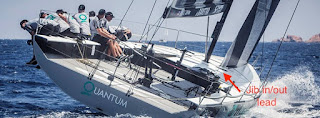
My red arrow in this picture points to the in/out jib track, which you can see just below the clew. The jib sheeting angle is every bit as important (often more so) than the main's sheeting angle. Notice also the main traveler position here - not even close to as high as in the pic above. I'd bet the mainsheet is so tight in this pic that the mainsheet winch is begging for mercy.
A tight leech is great in a lot of conditions - flat water and medium breeze prime among them. With a tight leech, you get to go fast and point high, but there is a tight groove*. Too tight a leech and the sail will stall*, cratering both your speed and pointing. This is why so many of you heard me say "when in doubt, ease it out" this spring.
A looser, twisted leech allows the sail to easily "spill" wind. This is great in light air to prevent stall, and also in heavy air to prevent excess heel. It also gives the boat a wide steering groove, which lets you go fast and point okay but lets you steer around and through chop without slowing down.
A great thought exercise while you are sailing is to think about which adjustment you'd prefer to make in different situations. Sailing along in flat water, fully hiked, and get a huge puff? Easing leech tension allows you to spill some of that excess power (there is also a thing in there about why Roy and I disagree so much about the truth of "ease/hike/trim," which is a topic for another day). Want to move bow forward relative to another boat? Keep leech tension on, ease sheeting angle a bit, and motor down over them. Big set of chop that you need to get through - twist the sails by having slightly looser leeches but tight sheeting angle is your fastest way through that.
Most of the boats you'll sail for the next couple of years don't give you the range of control options that would be ideal, but you need to start thinking about leech tension versus sheeting angle all the time. It's really important.
In a lot of boats, pulling on the sheet is responsible for pulling the sail both down and in. When you pull the sail down, you are first of all affecting the leech tension. When you pull the sail in, you are primarily affecting the sheeting angle. As you progress, more boats will offer you the opportunity to do one without the other. Being able to adjust the one without affecting the other opens up a lot of sail trim possibilities, but even when the two are connected (Lasers, school boats), being aware of what you're after can help a lot.
C420, I420, and 29er sailors get to disconnect the two on the mainsheet by using a bridle, and windward sheeting the jib lets us adjust the jib's sheeting angle without adding leech tension. 29er jib cars get pinned in different positions to adjust sheeting angle. You can't adjust them in real time like a lot of other boats let you do, but it's a good start. Vang sheeting in a Laser, where the vang is tight enough to keep the boom down even when you ease the sheet out, is another example of separating the leech tension and sheeting angle functions.
Some SG sailors will remember a very light day this spring when I told some skippers to sheet Z420 mains directly from the boom. This allowed them to pull the sail in without pulling it down. The picture below shows what I was after there.

This is a TP52 and I'll use them a lot to illustrate points, both because they have the full array of sail controls and because there are tons of easy to find pictures that work for what I want to show. You can clearly see that their boom is above centerline here. As you go up the main, at some point the leech is just on centerline, and then towards the top it is below centerline. There are a bunch of reasons why you'd want to do this, prime among them would be wind shear* which we'll discuss later.

My red arrow in this picture points to the in/out jib track, which you can see just below the clew. The jib sheeting angle is every bit as important (often more so) than the main's sheeting angle. Notice also the main traveler position here - not even close to as high as in the pic above. I'd bet the mainsheet is so tight in this pic that the mainsheet winch is begging for mercy.
A tight leech is great in a lot of conditions - flat water and medium breeze prime among them. With a tight leech, you get to go fast and point high, but there is a tight groove*. Too tight a leech and the sail will stall*, cratering both your speed and pointing. This is why so many of you heard me say "when in doubt, ease it out" this spring.
A looser, twisted leech allows the sail to easily "spill" wind. This is great in light air to prevent stall, and also in heavy air to prevent excess heel. It also gives the boat a wide steering groove, which lets you go fast and point okay but lets you steer around and through chop without slowing down.
A great thought exercise while you are sailing is to think about which adjustment you'd prefer to make in different situations. Sailing along in flat water, fully hiked, and get a huge puff? Easing leech tension allows you to spill some of that excess power (there is also a thing in there about why Roy and I disagree so much about the truth of "ease/hike/trim," which is a topic for another day). Want to move bow forward relative to another boat? Keep leech tension on, ease sheeting angle a bit, and motor down over them. Big set of chop that you need to get through - twist the sails by having slightly looser leeches but tight sheeting angle is your fastest way through that.
Most of the boats you'll sail for the next couple of years don't give you the range of control options that would be ideal, but you need to start thinking about leech tension versus sheeting angle all the time. It's really important.
Wednesday, April 29, 2015
Notes from Tabor Meet 4/29 At Home
I didn't get to see much of the A meet, but it sounds like it was a pretty thorough win, so congrats. We had a few more challenges in the B meet, and wound up on the wrong end of a 3-1 scorecard. Here's what I saw...
1. Starts. Even if the pin end is favored, on a short course like that, winning the pin does you no good unless you can either force the boats on your hip to tack away, or you can tack and cross them. A boat that is able to hang on your hip gradually gains the advantage over you, simply because eventually you have to tack and they will be the ones making the decision on when.
2. Starts part 2. Even if the pin end is favored, I prefer when we have a boat win the pin and then an opponent, and then one of us. Usually, not necessarily always but usually, a favored pin will also mean a port-tack-skewed beat, or at least a pretty big leftie. Having two boats at the pin will generally mean we have the two boats who are the last ones able to tack. Everyone else gets to tack earlier, sail on the lift, and either gets to sail at the mark or sail to the next shift more quickly.
3. Sail the longer tack first. Hopefully you have all heard this expression. If not, now you have. Oddly enough, people who grow up in cities or spend a lot of time in them have a very intuitive understanding of this concept. Think about that for a minute.
4. Unless you are in the act of trying to sail slowly, your job always includes sailing your boat absolutely as fast as it can go. Fast means VMG, not necessarily going through the water fastest.
5. Elevate, don't accelerate. This is likely to be different when sailing Z420s, but the 420s we have and most schools have simply don't accelerate very much in puffs. The best 420 sailors know how to turn puffs into pointing. The math to prove this is ridiculously simple, even for me, but at this point please just take it as a given (or as a postulate, if you will): learn to turn puffs into pointing.
6. Mark traps at mark 3 (leeward mark). This gets complicated. The standard mark trap setup is to be on starboard, to the left of the mark as you are looking downwind. That allows you to defend against the "suicide bomber" rounding and leaves you space to accelerate while pushing their first boat out, and defending against their second boat squeezing between you and the mark before you can turn around the mark. This setup works very well if you are in a 1,4, x combo. UNFORTUNATELY, we found ourselves in a 1, 5, 6 combo at one leeward mark today, and the starboard tack mark trap is super hard to execute against three opponents. Generally, their first boat will do try to draw you out away from the mark on a starboard reach, and try to make a gap for their second boat to squeeze through. If their second boat isn't able to squeeze through, their third boat will. Or, if you spend enough time messing around with their second and third boats, their first boat is probably around the outside and onto the offset leg. Either way, now they've turned a 2, 3, 4 into a likely 1, 3, 4. I won't mention what happened to us.
I think that there are two more effective approaches to the 1, 5, 6 mark trap than the standard trap. First is to start off as you would normally, but as soon as their first boat tries to draw you away from the mark, you gybe around the mark preventing other their boats from shooting through the gap. Basically, you get their first boat pointed away from the offset leg, and you gybe. Now you have their three boats making wide roundings, and ending up in the low lane on the offset leg. As soon as they gybe, you begin to walk them down the offset by over trimming your main and under trimming your jib. You are windward boat so try hard to keep their overlap broken. It should be relatively easy. If you are able to keep them from getting outside overlaps, you can set a good trap there and force all of their boats into wide roundings.
1, 5, 6 is a pretty desperate situation. The most effective thing you can do is play for time and bring your teammates back into the mix by exerting control in the few moments when you are able to negatively affect all three of their boats. The go-for-broke hero move generally doesn't work at all there.
The better course is, of course, let's try and avoid the 1, 5, 6 combo as much as we possibly can.
1. Starts. Even if the pin end is favored, on a short course like that, winning the pin does you no good unless you can either force the boats on your hip to tack away, or you can tack and cross them. A boat that is able to hang on your hip gradually gains the advantage over you, simply because eventually you have to tack and they will be the ones making the decision on when.
2. Starts part 2. Even if the pin end is favored, I prefer when we have a boat win the pin and then an opponent, and then one of us. Usually, not necessarily always but usually, a favored pin will also mean a port-tack-skewed beat, or at least a pretty big leftie. Having two boats at the pin will generally mean we have the two boats who are the last ones able to tack. Everyone else gets to tack earlier, sail on the lift, and either gets to sail at the mark or sail to the next shift more quickly.
3. Sail the longer tack first. Hopefully you have all heard this expression. If not, now you have. Oddly enough, people who grow up in cities or spend a lot of time in them have a very intuitive understanding of this concept. Think about that for a minute.
4. Unless you are in the act of trying to sail slowly, your job always includes sailing your boat absolutely as fast as it can go. Fast means VMG, not necessarily going through the water fastest.
5. Elevate, don't accelerate. This is likely to be different when sailing Z420s, but the 420s we have and most schools have simply don't accelerate very much in puffs. The best 420 sailors know how to turn puffs into pointing. The math to prove this is ridiculously simple, even for me, but at this point please just take it as a given (or as a postulate, if you will): learn to turn puffs into pointing.
6. Mark traps at mark 3 (leeward mark). This gets complicated. The standard mark trap setup is to be on starboard, to the left of the mark as you are looking downwind. That allows you to defend against the "suicide bomber" rounding and leaves you space to accelerate while pushing their first boat out, and defending against their second boat squeezing between you and the mark before you can turn around the mark. This setup works very well if you are in a 1,4, x combo. UNFORTUNATELY, we found ourselves in a 1, 5, 6 combo at one leeward mark today, and the starboard tack mark trap is super hard to execute against three opponents. Generally, their first boat will do try to draw you out away from the mark on a starboard reach, and try to make a gap for their second boat to squeeze through. If their second boat isn't able to squeeze through, their third boat will. Or, if you spend enough time messing around with their second and third boats, their first boat is probably around the outside and onto the offset leg. Either way, now they've turned a 2, 3, 4 into a likely 1, 3, 4. I won't mention what happened to us.
I think that there are two more effective approaches to the 1, 5, 6 mark trap than the standard trap. First is to start off as you would normally, but as soon as their first boat tries to draw you away from the mark, you gybe around the mark preventing other their boats from shooting through the gap. Basically, you get their first boat pointed away from the offset leg, and you gybe. Now you have their three boats making wide roundings, and ending up in the low lane on the offset leg. As soon as they gybe, you begin to walk them down the offset by over trimming your main and under trimming your jib. You are windward boat so try hard to keep their overlap broken. It should be relatively easy. If you are able to keep them from getting outside overlaps, you can set a good trap there and force all of their boats into wide roundings.
1, 5, 6 is a pretty desperate situation. The most effective thing you can do is play for time and bring your teammates back into the mix by exerting control in the few moments when you are able to negatively affect all three of their boats. The go-for-broke hero move generally doesn't work at all there.
The better course is, of course, let's try and avoid the 1, 5, 6 combo as much as we possibly can.
Thursday, March 3, 2011

Subscribe to:
Posts (Atom)